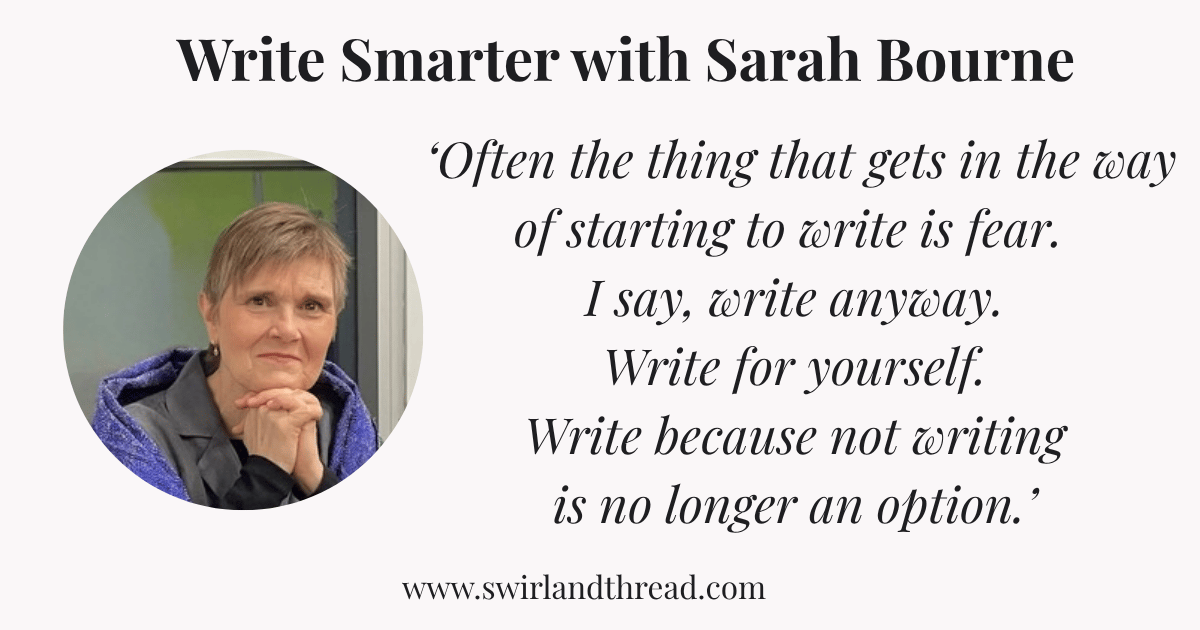
On this week’s Writer Smarter Blog I am delighted to welcome Sarah Bourne, the author of five novels of contemporary domestic drama and two of historical (WW2) fiction. Sarah was born and brought up in London but, after wandering the world for several years, settled in Sydney where she raised her family. She is a counsellor and yoga teacher, as well as writing books, and loves to go to the beach or get out into the Australian bush with friends at weekends.
You will find Sarah at: Facebook & Instagram
Hello writers, aspiring writers, readers and everyone else interested in the writing process! I hope you’re all well.
All writers have their own way of doing things. That’s not a very helpful statement, but I believe it’s true. The things that they all do, however, are many and important.
All writers are first of all readers. Every time you read a book, you are learning about the craft of writing and the more widely you read, the better. Even if you want to write in a particular genre, it is useful to read anything and everything that comes your way in order to assimilate the structure of story, the narrative arc, the development of characters, the themes, tropes, and overall cohesiveness of a book.
Writers are usually good observers of people, places, events. They squirrel away snippets of information for later use. But more than that, they dream, allowing those small fragments to become bigger: The man who was picking rubbish out of a bin? He’ll end up finding something of value that solves a murder in your next book. The woman waving her hands around as she bellows into her phone? She’ll become the CEO of a startup in financial distress with two small children, a philandering husband and a crooked business partner. You get my drift, I’m sure.
Ideas can come from the unlikeliest of places if you’re open and receptive. One of my books was kick-started by a radio interview I heard about solitary confinement. Another by a conversation with a fellow dog-walker and a third by wondering what had happened to an intriguing woman I had a chance meeting with. Stay open and ideas will come.
Some writers say that the plot comes to them whole and ready to write. Lucky them! For me, the process is not as easy. It’s often characters that come to me first, and I write a detailed profile of each one, so I know as much about them and how they’ll behave in any situation as possible. Then I devise a fairly loose plot – often a vague notion of where the book will be set, what the themes will be, what the characters will have to face, and an ending. It’s a scary and exciting time – embrace it.
Many writers, even authors of fiction, do some (or a lot) of research before or during the writing of a book. I find that this stage is really helpful in fleshing out the plot – it’s almost like it starts coming alive in my head. I try not to rush this stage, because if I do, I usually find myself on shaky ground later on. Plus, I’ve learned to enjoy it!
Plotter or panster, that is the question – and there is no right answer. I tend to plot more now than I used to, but not to the extent that I know exactly what will happen in every chapter or scene. I like to have an ending and a few pivotal scenes in mind before I start, although sometimes my characters seem to develop minds of their own and take me in new directions. Sometimes they’re right, other times I rein them in.
Nothing you write is ever wasted. I have deleted thousands of words from manuscripts I’ve written. I have a file full of them. Some of them are great words and sentences, others are not, but they all hold ideas, descriptions or themes which can inspire a whole new book or fill in gaps in a current work. Don’t be afraid to delete!
And don’t be afraid to start. I’m sure many great books haven’t been written because the aspiring writer is full of self-doubt, imposter syndrome, lacks the time or the confidence or can’t start until the house is immaculate, garden is perfect, the children are grown up…there are so many excuses not to do it. Often the thing that gets in the way of starting to write is fear. Fear that you will fail, that other people will judge you negatively, that they’ll think you’re silly for even trying. I say, write anyway. Write for yourself. Write because not writing is no longer an option.
And good luck to you!

[ About The Paris Resistance ]
Paris, 1942.
In a country at war, one woman must risk everything for love, freedom and justice.
In Nazi-occupied Paris, Miriam’s world shatters when her mother and sisters are taken away. Hidden by courageous neighbours and forced to live under a false identity, she survives by staying invisible. But Miriam won’t stay silent. Driven to find her family, she joins the French Resistance as a courier, risking everything to carry secret messages through occupied Paris.
Across the countryside, Pierre, a young Resistance fighter, seeks vengeance for his brother’s murder. His quest takes him deep into enemy territory, where the stakes are higher than ever.
When their paths collide, Miriam and Pierre are united by their shared quest for justice. As the war ends, their fight for peace, healing, and redemption begins. Together, they must confront the scars of the past and face a new battle for survival — where love may be the only hope for a future, in a world forever changed by war.



Love these posts, keep them coming! xx
Thanks so much Nicki. Only two left!! x