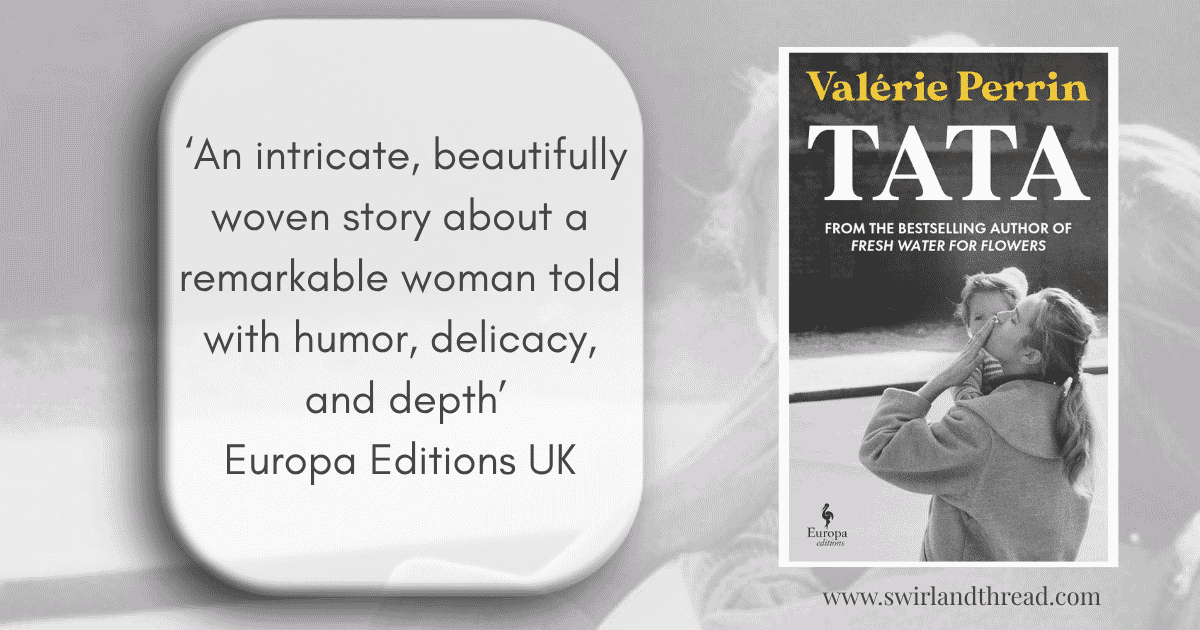
[ About Tatá ]
When Agnes hears from the local police her Aunt Colette has died, she can’t believe her ears. Her father’s sister Colette, her Tatá, died three years ago and has been resting in peace in the cemetery of Gueugnon.
Agnes is called to identify the body: there is no doubt, it’s Aunt Colette. But then, who rests under the stone engraved with Colette’s name? And why did she fake her own death? So begins an investigation back in time, as Agnes pieces together the multitude of stories that lie behind her aunt’s second death.
An intricate, compelling web of stories told with irony, delicacy and depth, Tatá will keep readers glued to every page.
[ My Review ]
Tatá by Valérie Perrin published June 18th with Europa Editions UK and is described as ‘the most incontrovertible proof thus far that there is nobody better than Valérie Perrin at capturing the ebb and flow of life in all its glorious unpredictability.’
This is the fourth book that I have read by Valérie Perrin, having previously loved Fresh Water for Flowers, Three & Forgotten on Sunday. Beautifully translated by Hildegarde Serle, Valérie Perrin has a way with words, immersing the reader right into middle of all her novels. In Tatá she takes us to Gueugnon, a commune in France, known for its football team, FCG (Football Club Gueugnon) and its stainless-steel production.
Agnès Dugain is left reeling when she receives the shocking news that her aunt, Colette Septembre, is dead. Three years previously Agnès had been living in Los Angeles when she had been notified that Colette had died. She had always been close to her aunt but a local friend insisted that it wasn’t worth Agnès making the trip and to leave it with him to organise the funeral arrangements. Back in France now, Agnès is stumped. Who died three years previously? Who is in the coffin instead of her aunt? Where was Colette hiding for the past three years?
Agnès is involved in film production with a string of successes under her belt. She thought her life was sorted, with her actor husband, Pierre, and their daughter Ana. But when her marriage imploded, she floundered, returning to Paris with no motivation to get her life back on track. Agnès had quite a serious childhood with two classical musicians for parents. Every summer she would come to Gueugnon and stay with her aunt Colette, hanging out with the local children. It was an idyllic and carefree time for Agnès. She, at times, privately ridiculed her aunt, thinking her dowdy and stuck in her ways, but their relationship developed over the years and Agnès came to value their time together.
On hearing of her aunt’s demise, for the second time, Agnès packs a bag and travels to Gueugnon to identify the body. On seeing that it is really Colette, Agnès is understandably emotional and very confused. She is given a suitcase of tape recordings that Colette left for her so she decides to stay in Colette’s house to listen to the tapes, in an attempt to get to the bottom of this very disconcerting situation. As confusion reigns it is clear that something is amiss and as Agnès starts to hear Colette’s voice a story unfolds, one that is beyond anything she could have imagined.
What evolves is a mystery spanning decades, as many truths are revealed, with multiple threads all seamlessly interweaving their way through the story. There is a great underlying sadness in this novel, one that lingers in the mind. Aside from the fictional aspect, there are specific, and more loose, references to factual historic injustices that have impacted generations of families, and continue to do so today. There is much movement through the chapters, as the story switches from thread to thread. This could cause confusion for some readers so you do need to be aware of the different voices at any given moment.
On completing Tatá I was convinced that it was inspired by real-life events, and the acknowledgements seemed to imply something similar. However, while Perrin does thank the various people who contributed to her research, I understand that it is a complete work of fiction, except for the town of Gueugnon. An intimate novel with a vast cast of characters, there are some elements of Tatá that could have irritated me, but that didn’t happen. It is a slow-burner but, as the pace picked up, and truths were exposed, I was left quite shattered. There is a real sense of yearning for what might have been throughout this novel, transcending through the years and through the chapters. Tatá is a novel that deserves time and patience, with plenty of reward at the close, Valérie Perrin has written an unpredictable and vibrant story where the chaos of real-life is emulated on the page, another emotional novel from this wonderful French author, a truly captivating read.
[Thank you to Europa Editions UK for a copy of Tatá in exchange for my honest review ]
[ Bio ]

Valérie Perrin was born in 1967 in Remiremont, in the Vosges Mountains, France. She grew up in Burgundy and settled in Paris in 1986. Her novel The Forgotten Sunday (2015) won the Booksellers Choice Award and the paperback edition has been long-selling best-seller since publication. Her English-language debut, Fresh Water for Flowers (Europa, 2020) won the Maison de la Presse Prize, the Paperback Readers Prize, and was named a 2020 ABA Indies Introduce and Indie Next List title. It has been translated into over thirty languages. Figaro Littéraire named Perrin one of the ten best-selling authors in France in 2019, and in Italy, Fresh Water for Flowers was the best selling book of 2020. Perrin now lives in Normandy