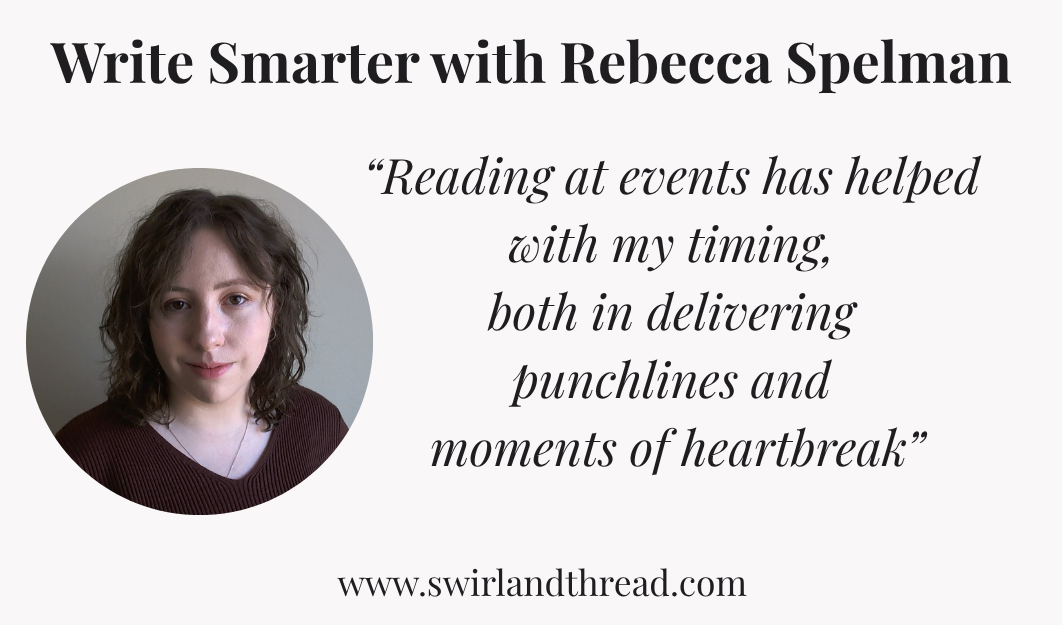
On this week’s Write Smarter Blog, I am delighted to introduce Amsterdam-based Irish author Rebecca Spelman. Starting off as a playwright in Galway, Rebecca now writes a mix of novels, short stories, and poetry. Her work often centres on speculative scenarios or reflective moments that ask, “What if…?” You can read her work on Substack or see what she’s up to on Instagram.
What I’ve learned from reading my work at live events
I’ve read my writing at quite a few events; open mics, poetry nights, and storytelling events, to name a few. It’s a concept a lot of writers find daunting, and I completely understand that. Sharing your work in any capacity can be scary; throw in public speaking and stage lights, and suddenly you wonder how this happened to you. But I’ve noticed growing audiences at these events in recent years, and if people want to hear stories, why not share them?
I think it’s something every writer should try at least once, but before you make your on-stage debut (or return), here are a few things I’ve learned (and you could learn too) from reading work live:
Character and narrative voices become stronger
I’ve heard many writers talk about their struggle with voice- finding it, nurturing it, and keeping it consistent. Nothing makes a voice reveal itself to you like performing it to others. When you read on stage, you give your story more panache than you would reading to yourself. You accentuate and embolden to grab your audience’s attention, often in places you didn’t expect.
You don’t need to be a “performer” to do this- it often happens quite naturally when someone starts to tell a story. When on stage, you want to get your message across by connecting with your audience, leading you to dial up the emotion a little. This has shown me some emotional shades to characters I hadn’t previously seen, as well as some narratives that weren’t as impactful as I thought. It’s a strange experience to read a passage live, realising in real time that not everything you feel about your piece has made it on to the page.
I get a better feel for the balance of comedy and tragedy
The amount of times audiences have laughed at unexpected moments in my readings is astounding. They weren’t laughing at me (I think); it’s just that lines I’d sprinkle in to ease the tension often did a much better job than expected. I’ve also shared quite vulnerable pieces on stage and seen tears in the audience. Happiness and sadness are so subjective, and it’s only when you share your work with an audience that you can gauge if your reaction lines up with others. There’s a big difference between a friend telling you, “It was funny,” and hearing the exact moments when people laugh. I think reading at events has helped with my timing, both in delivering punchlines and moments of heartbreak.
Presenting work in a new way gives me new space to explore
There are so many live events where writers must work with a theme, time slot, or format. These can be really useful prompts, and I’ve written several pieces I’ve really liked just so I had something to read at an event. I’ve tried different short story forms, poetry, short plays, and even would-be short film scripts; formats I’d never try if I were only writing for my blog or literary journal submissions. As I’ve read more work live, I’ve learned about different formats where performance is half the message, and how I can convey more to audiences than I could on the page.
New people discover my work, and I discover theirs
This is my favourite part of sharing my work- getting stories out into the world and seeing other people connect with them like I did. When you get on stage at a live event, dozens (or more) people who have never heard of you now know about your work. They might even like it, and want to hear more! Yes, it can feel scary, but the wonderful thing about so many of these events is that everyone else getting on stage feels the exact same way. I’ve met some incredibly kind, supportive writers who help each other get on stage and shine. I also love listening to the other pieces being read at these events, especially when we all interpret the same theme in different ways. It makes me reconsider the angle I took, and I definitely approach prompts more creatively now because of what I’ve been exposed to.
I won’t pretend that reading live isn’t a little bit nerve-wracking. But isn’t sharing your work on a blog, or in a magazine? While the prospect of an audience’s reaction might scare you, the reality is a wonderful thing to experience. Give it a go sometime and find out what your words sound like to a room full of new people.