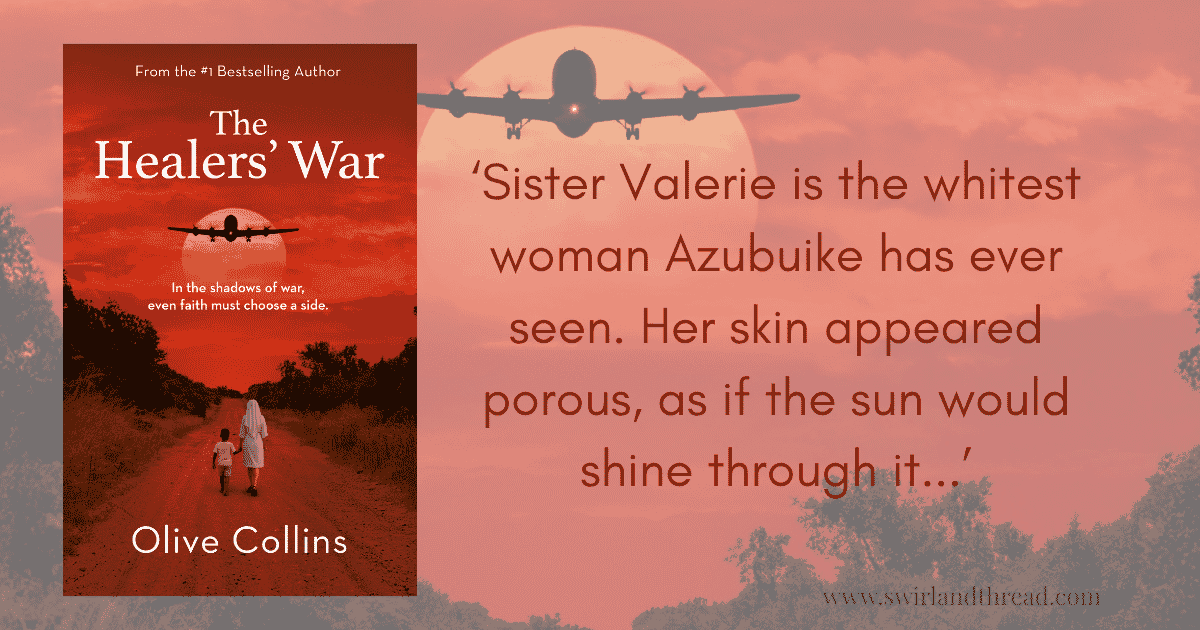
Inspired by real events during the Biafran War (1967–1970), The Healers’ War follows three lives bound together by famine, faith, and survival in a besieged corner of Eastern Nigeria.
[ About The Healer’s War ]
As war encroaches upon their region, Irish missionaries refuse to flee, instead building feeding centers, clinics, and a secret airstrip to smuggle in aid and evacuate children. Among them is Valerie Corrigan, a young Irish woman who arrives seeking purpose after heartbreak. But as the war closes in and the moral certainty of her mission begins to fracture, Valerie is forced to confront betrayal, violence, and troubling truths within her own congregation.
Amid the chaos, Valerie meets Azubuike, a precocious nine-year-old boy born in a village where time is measured not in numbers, but in events. Banished from his home because of his mother’s volatility, Azubuike is sent to live with the missionaries. There, he must adapt to a new world—one defined by unfamiliar gods and foreign calendars. His friendship with Sister Valerie becomes a rare light in a darkening world.
When Valerie’s former lover, Oscar, returns, old wounds reopen, and the lives of Valerie, Azubuike, and Oscar become dangerously entwined.
[ My Review ]
The Healers’ War by Olive Collins is described as ‘a story of survival, faith, and the impossible choices people make in the shadow of war.’
I was a 1970s child so I knew nothing about The Nigerian Civil War except that I recall talk, in later years, of starving children in Africa and the word Biafra. When I read the blurb of Olive Collin’s novel I was immediately drawn to it as I knew it was a piece of history that I was embarrassingly ignorant about.
In 1967 a region of Nigeria declared independence. Home to the Igbo people, this Eastern region of the country was struggling to maintain its identity and culture. They were often well-educated and held good jobs, causing friction among other cohorts of Nigerian society. With many Igbo working in the Northern regions, their prosperity led to unprovoked attacks, many quite brutal, leading to massacres of communities. Those in power attempted to come an agreement but failed, leading to the Igbo declaring Biafra in the South East of Nigeria, a new republic. What followed was a catastrophic war that left thousands dead as the forces of the Northern Federal Government rampaged through the Biafran region leaving death and destruction in their wake, while the world watched on.
In the midst of this brutality there were Irish missionaries who sacrificed so much in the hope of assisting these communities in Biafra that were eventually cut off from supplies and medical care. Olive Collins wraps the most heartbreaking and emotive story around this heinous period in history, interweaving fact and fiction with the most authentic of characters.
Central to the novel is Valerie Corrigan, a young woman from Achill Island off the West Coast of Ireland who had an idealised version of becoming a missionary nun purely based on a relative who had gone to Africa before her. Valerie trained in Dublin and had an emotional connection to Oscar Williamson, a well-to-do Englishman that she knew from childhood, as his family had a home on Achill. Over the years their friendship developed but a moment arrived that blindsided Valerie and spurred her to fulfil her ambition of working in Africa.
Before there was any war, Valerie arrived to her new home in the south east of Nigeria, fascinated with her new surroundings and the welcome of the local Igbo community. She had moments of doubt about her vocation but on any given day, she saw or did something that would pull her back to her new reality. When talk of war was whispered, none of them had any idea of the horrors that awaited them. Over the following months as the guns got nearer, the tension mounted. Valerie befriended a young boy, nine-year-old Azubuike, and a lovely relationship developed between but as the clouds darkened and the bombs started to fall everything changed.
The level of research in this novel is astounding. Olive Collins immerses the reader right into the heart of this story as the fear, anguish and pure violence of that time takes hold. It is quite shocking to read about how certain governments supported the federal government with arms and more, leaving the Igbo communities starving and defenceless. We all have seen those horrifying pictures of children who suffer from kwashiorkor, a life-threatening condition primarily caused by malnutrition. In The Biafran War there were thousands of children who died from this famine-induced illness and for the missionaries, at that time, terrible choices had to be made.
It’s hard to believe that similar wars continue to ravage communities today. We have so much available to us…and yet. Valerie Corrigan and her companions may be fictional but their story is one of the many brave men and women who tried to assist the starving and brutalised Igbo people. Olive Collins forces us to look back and not forget what happened in Nigeria during that time. Through her words and her sensitive handling of such inhumane acts of cruelty, she imbues hope for a future, hope for peace. With a stunning and vivid cast of characters, The Healers’ War is a compassionate, provoking, affecting read, one that will stay with me for quite some time.
‘In the years after the war, many traces of Biafra were deliberately erased, including graves connected to humanitarian efforts. This novel is, in part, an attempt to remember those stories and the people caught within them.
I hope readers come away not only with an understanding of a forgotten chapter of history, but also with a renewed appreciation for the individuals who, in the darkest of times, chose compassion over indifference’
– Olive Collins
[ Thank you to Olive Collins for a copy of The Healers’ War in exchange for my honest review ]
[ Bio ]

A bestselling Irish historical fiction writer from the Midlands, Olive writes novels that explore stories spanning continents and generations, with settings ranging from Ireland and Jamaica to the American and Nigeria.
After many years of travelling and living abroad, she returned to her roots in Thurles, County Tipperary, where she now lives and writes. Through her work, she brings forgotten histories and untold stories to life, connecting readers with the people and events that have shaped our world.