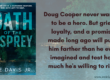
‘A campaign in France that began too late in the season, a rebellion in London that paralyzed king and Commons, and a young serf named Haukyn caught up in both:
therein lie the seeds of The Arrows of Fealty.‘
The Arrows of Fealty by Jill MacLean will publish September 21st with OC Publishing and is described as ‘medieval historical fiction’. It is the standalone sequel to The Arrows of Mercy, which was a finalist at the Whistler Independent Book Awards, and tells the story of Edmund of Flintbourne’s son.
In celebration of its upcoming release I have a short extract to share with you today with additional information, including that all important Pre-Order/Purchase link. Do enjoy!

[ About The Arrows of Fealty ]
Haukyn is a serf who owes fealty to the lord of the manor and whose life is tied to the soil, yet he craves adventure beyond the boundary stones of his village. In 1373, he leaves for John of Gaunt’s campaign in France. There, during five months of combat and loss, futility and atonement, he learns how armour-clad knights can be brought as low as any serf.
Home again, he is caught between two women, pretty Annabel and Ilotte of the sloe-black eyes. Neither marriage nor fatherhood tames his restless spirit. When a knight who was his sworn enemy in France becomes the new lord of the manor, Haukyn leads his neighbours in rebellion against ancient custom and unjust taxation.
England’s southern counties march in open revolt on London, where Haukyn witnesses the king grant freedom to every serf in the country. Unimaginable freedom. A freedom that will bring consequences.
The Arrows of Fealty – Pre-Order/Purchase Link
[ Extract ]
Opening Extract – The Arrows of Fealty by Jill MacLean
…a day of thievery…
He’ll not forget this sight til the day death claims him.
Blare of trumpets, heartbeat thud of drums, and in the distance, the army’s vanguard stirs into motion. Bright-hued banners flaunt themselves in the wind off the Channel. Pale sunlight dances on the polished steel of armour. Horses snort, curvet, and fart. The captain of his retinue bellows, “Giddup!” and he, Haukyn of Flintbourne, is riding in John of Gaunt’s army, leaving Calais for an unknown world to the south, a world of adventure, where he’ll take part in something of far greater import than himself and his small village. This war will be one long raid on the French countryside, Calais to Bordeaux, a chevauchée that rounds up beasts to feed the army and grain to make its bread, and burns everything else. Battles, too, which they will win, for English archers are unbeatable. And for the victors? Loot, from dukes to lowly varlets.Eighteen winters to his name, and he’ll go home rich.
Two dukes, three earls, knights, and squires, he’s ranked them in their proper order already and is in awe of their magnificence, the sheer splendour of their vivid coats of arms and of armour whose cost is so far beyond his reach as to be unimaginable; he’s but a humble serf, a villein, lowest of the low. By craning his neck, he can see John of Gaunt, Duke of Lancaster, son of good King Edward. The duke’s red and blue jupon is emblazoned with gold lions and fleurs-de-lys, his very vestments laying claim to France. He’s astride his destrier, a huge black horse bred for war. Haukyn bends forward and rubs his mare’s sleek chestnut coat. Modge is a cob, sturdy and much loved, although he tries not to display the bond between them for fear of jests.
As a little boy, he’d trembled at the very word war, for he’d heard his father’s choked screams in the night and had listened to his mother say softly, “Wake up, Edmund, tis only a nightmare ’bout France.”
A nightmare? Did herds of mares run through the darkness? He’d never dared ask.
But now? He’ll not wallow in nightmares. Modge swishes her tail. The smell of close-pressed horseflesh fills his nostrils—tis how Heaven must smell. His friends Piers and Willem are riding to one side of him, and a smile stretches his face. Harnesses jingle, armour clanks (a noise he hadn’t expected, a somewhat undignified noise), and the trumpets cry Victory! Glory! Aquitaine for England!All day they ride, then camp for the night in an open field, guards posted along its perimeter. At dusk, half their retinue is assembled by their captain, Fulk of Hertford, a stocky, slab-faced man whose gravelled voice Haukyn had quickly learned to obey. Ten archers and two scouts will leave at first light and ride east with empty packs. Two waggons in the rear. Burn the standing crops. Poison the wells. Kill the serfs that get in your way. Oxen, cows, pigs, sheep, bring ’em back alive along with any sacks of grain. Loot if you can carry it, up to you. No attacking of towns or churches. Twould displease the Duke of Lancaster, and we wouldn’t want that, would we.
Nigh dark and Fulk is about to dismiss them when shambling toward them comes a knight in mail and jupon; he has the smallest head Haukyn has ever seen atop a man’s shoulders, his nose netted with purple veins close-hued to Gascon burgundy. Fulk shouts, “Attenshun!”
They snap to attention. The knight says, “And what transpires here?”
“A raid before dawn, Sir Nigel. To the east.”
“Ah. Good. And you’ll return with vittles for the army?”
“Aye, sir, God willing.”
“The ways of God are ever inscrutable,” Sir Nigel says sagely and to no purpose that Haukyn can discern. A snicker rises in his throat. “You and your men will do well—er, I’ve forgotten your name?” He looks around vaguely, as though a name might spring from the campfires.
“Fulk, sir. Fulk of Hertford.”
“Of course, of course.” He nods earnestly, his wisps of greyinghair nodding with him, and wanders off in the direction he’d come from.
Fulk raises his voice. “Rouse yerselves afore dawn. Dismissed!” Haukyn frowns at Piers. “Er, your name?”
“Piers, sir. Piers of Hungerford.”
Willem snorts. “Better to follow a gaggle o’ geese than that dimwit.” “Fulk should be knighted for putting up with him,” Piers adds. Haukyn draws himself to his full height and nods so that hishair flops over his forehead. “The ways of knighthood are ever inscrutable,” he says.
The three of them throw arms around each other’s shoulders, laughing, and head for their bedrolls. But Haukyn is slow to sleep. So Sir Nigel of Winchester heads their retinue and six others besides, Fulk all deference though he is a man ill-suited to defer to anyone, let alone a pea-brained noble. God help all seven companies should Sir Nigel ever lead them into battle, and how can such a dolt be a knight banneret?
No matter. Fulk will be giving the orders on the morrow’s chevauchée, and already he trusts Fulk, a soldier as tough as last year’s jerky. A thrill streaks his nerves, edged with apprehension. On the hard ground, his bedroll argues with him most of the night, although his mare sleeps peaceably enough. Dark when they’re roused. He pisses, chews bread and hard cheese, fills his waterskin, wraps Modge’s harness in soft cloth, and they set off, Willem onone side of him, Piers on the other, the filthy-faced archer called Benedict riding nearby, a felon who’ll be pardoned for partaking in this campaign and who, given the chance, would throttle the blessed Virgin.
As they speed to a trot, Haukyn’s chain mail rustles and his heart hammers at his ribcage. His hard leather helmet, iron-rimmed, digs into his forehead. Bowstave, two quivers, each with a sheaf of ash arrows, sword and dagger at his waist, and he’s grateful for the warmth of his quilted leather doublet.
From the black trees a crow flies straight for them. Willem says, “A bad omen.”

[ Bio ]
Jill MacLean has a BSc with honours from Dalhousie University, and a master’s in theological studies from the Atlantic School of Theology.
Her years of writing genre fiction taught her the basics of storytelling. An excellent, and demanding, full-year poetry course at St. Mary’s University in Halifax and a three-year mentorship with a professor of English and much-published poet in Winnipeg honed her love of language and her respect for the power of words.
Her poetry collection, The Brevity of Red, was shortlisted for two awards. Her eight-year-old grandson then asked her to write him a book, which, three years and three rejections later, was published as The Nine Lives of Travis Keating. Two more middle-grade and two young adult novels followed. Altogether these books won four awards and received many nominations, four international, including the prestigious White Ravens Honour List in Munich for Nix Minus One. Two of the novels are in the Nova Scotia school system.
Wanting a change and the challenge of an adult audience, Jill delved into her long-time fascination with the medieval period. In 2023 The Arrows of Mercy was a finalist for the Whistler Independent Book Award sponsored by The Writers’ Union of Canada.
Jill loves canoeing, gardening, listening to classical music, and, of course, reading. She lives in Bedford, Nova Scotia, near her family.
You can read more about Jill and her publications on her website: jillmaclean.mywriting.network