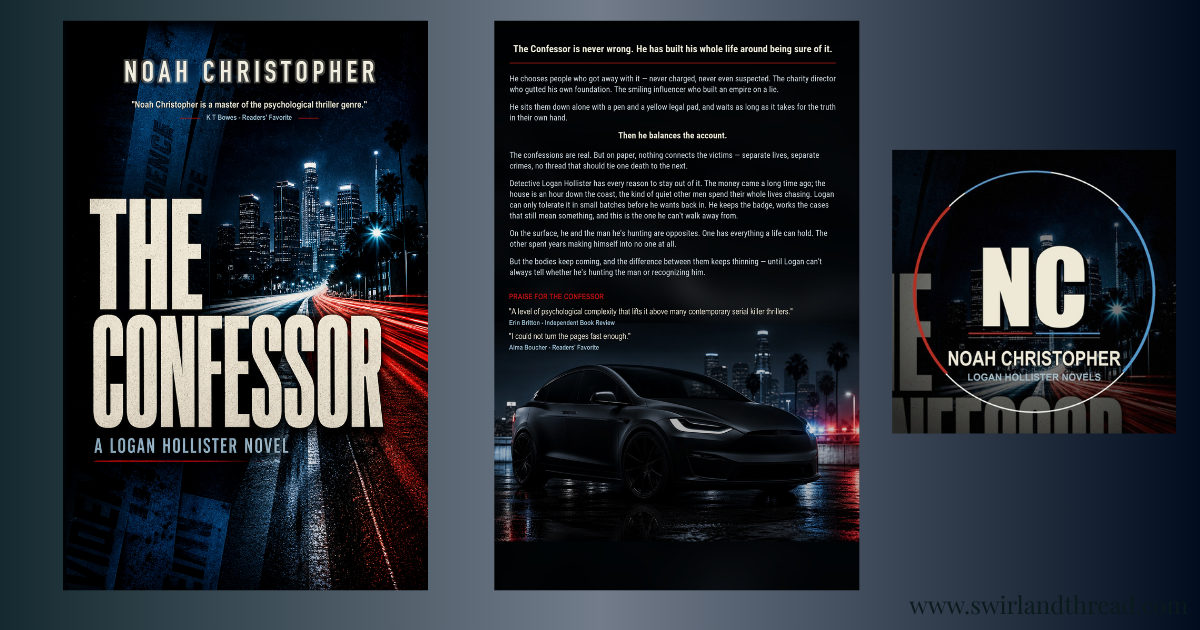
Los Angeles has always had secrets. Now someone is making powerful people write the truth before they die. Detective Logan Hollister knows the difference between truth and justice. He also knows how easy it is for a man to confuse the two when rage starts calling itself righteousness.
The Confessor by Noah Christopher published July 4th. It is the first book in an LA based series featuring Detective Logan Hollister and is described as ‘a cat-and-mouse thriller where the line keeps moving‘. In celebration of its recent release Noah Christopher has written a piece for us about the dilemma attached to morally grey fiction and its ability to cause us inner conflict and confusion. You will also find more details about the book below. I do hope you enjoy!
[ Why Morally Gray Crime Fiction Gets Under Our Skin by Noah Christopher ]
The easiest villain to condemn is the one who wants something monstrous. The harder villain—the one who follows us after the last page—is the one who has correctly identified a real injustice and chosen an unforgivable way to answer it.
Morally gray crime fiction should not make murder morally gray. If the story becomes uncertain about whether killing is wrong, the tension collapses into a slogan. The more unsettling question is whether a person can be wrong in action and right in diagnosis. A vigilante may be a murderer and still expose failures that polite society would rather ignore. Readers can reject the punishment while recognizing the grievance, and that divided response is where the story begins to tighten around them.
The genre works best when the targets are not secretly innocent. That is the tempting escape hatch: reveal that the supposed wrongdoers were misunderstood, and the reader can return to solid ground. But solid ground is not the point. If the victims really harmed people, escaped consequences, and built respectable lives over what they buried, then the detective is not merely protecting the innocent from a predator. He is defending the boundary between justice and private vengeance—even when the people inside that boundary are difficult to defend.
The public becomes part of the pressure. A city watching from a distance does not have to process crime scenes, notify families, or prove a case beyond a reasonable doubt. It sees a system that failed and a killer producing results. Sympathy grows because the outcome feels emotionally clean: a guilty person is exposed, an old debt is paid, and one more secret is dragged into daylight. But emotional clarity can be dangerous. The moment people decide that a victim deserved what happened, they begin granting someone the authority to choose who deserves to live.
For the detective, that creates a conflict deeper than catching the culprit. His duty is to uphold a process that has already failed some of the people watching him. He may understand their anger. He may even share pieces of it. Yet he has to stop a killer whose argument gains strength every time another confession proves true. The chase becomes a test of whether the law can remain legitimate when its imperfections are no longer abstract.
This is why recognition is often more powerful than simple opposition. A hero who sees nothing of himself in the villain can keep the case at arm’s length. A hero who recognizes the same impatience, the same disgust with excuses, or the same hunger for a clean answer has to police more than the streets. He has to police the story he tells himself about why his own judgment is different. The villain is dangerous not because the hero might suddenly approve of murder, but because the villain turns familiar moral instincts into permission.
That tension shaped The Confessor. The killer targets people who escaped justice and forces each one to leave the truth behind in their own handwriting. LAPD detective Logan Hollister must stop him while Los Angeles becomes increasingly fascinated by the pattern. The confessions are real. The supporting evidence holds. Every solved secret makes the next murder easier for the public to rationalize—and makes Logan’s job harder.
Morally gray crime fiction gets under our skin because it denies us the comfort of choosing between truth and evil. Sometimes both arrive in the same room. The villain’s point may be accurate. His answer may still be monstrous. The detective’s task—and the reader’s—is to hold those facts together without letting either one erase the other.
The Confessor – Purchase Link
[ About The Confessor ]
A killer is making Los Angeles confess.
The Confessor is never wrong. He has built his whole life around being sure of it.
He chooses people who got away with it — never charged, never even suspected. The charity director who gutted his own foundation. The smiling influencer who built an empire on a lie.
He sits them down alone with a pen and a yellow legal pad, and waits as long as it takes for the truth in their own hand.
Then he balances the account.
The confessions are real. But on paper, nothing connects the victims — separate lives, separate crimes, no thread that should tie one death to the next.
Detective Logan Hollister has every reason to stay out of it. The money came a long time ago; the house is an hour down the coast, the kind of quiet other men spend their whole lives chasing. Logan can only tolerate it in small batches before he wants back in. He keeps the badge, works the cases that still mean something, and this is the one he can’t walk away from.
On the surface, he and the man he’s hunting are opposites. One has everything a life can hold. The other spent years making himself into no one at all.
But the bodies keep coming, and the difference between them keeps thinning — until Logan can’t always tell whether he’s hunting the man or recognizing him.
[ Bio ]
Noah Christopher is the author of The Confessor.
He is at work on the next Logan Hollister novel.
Find him at WLTLH.com.


